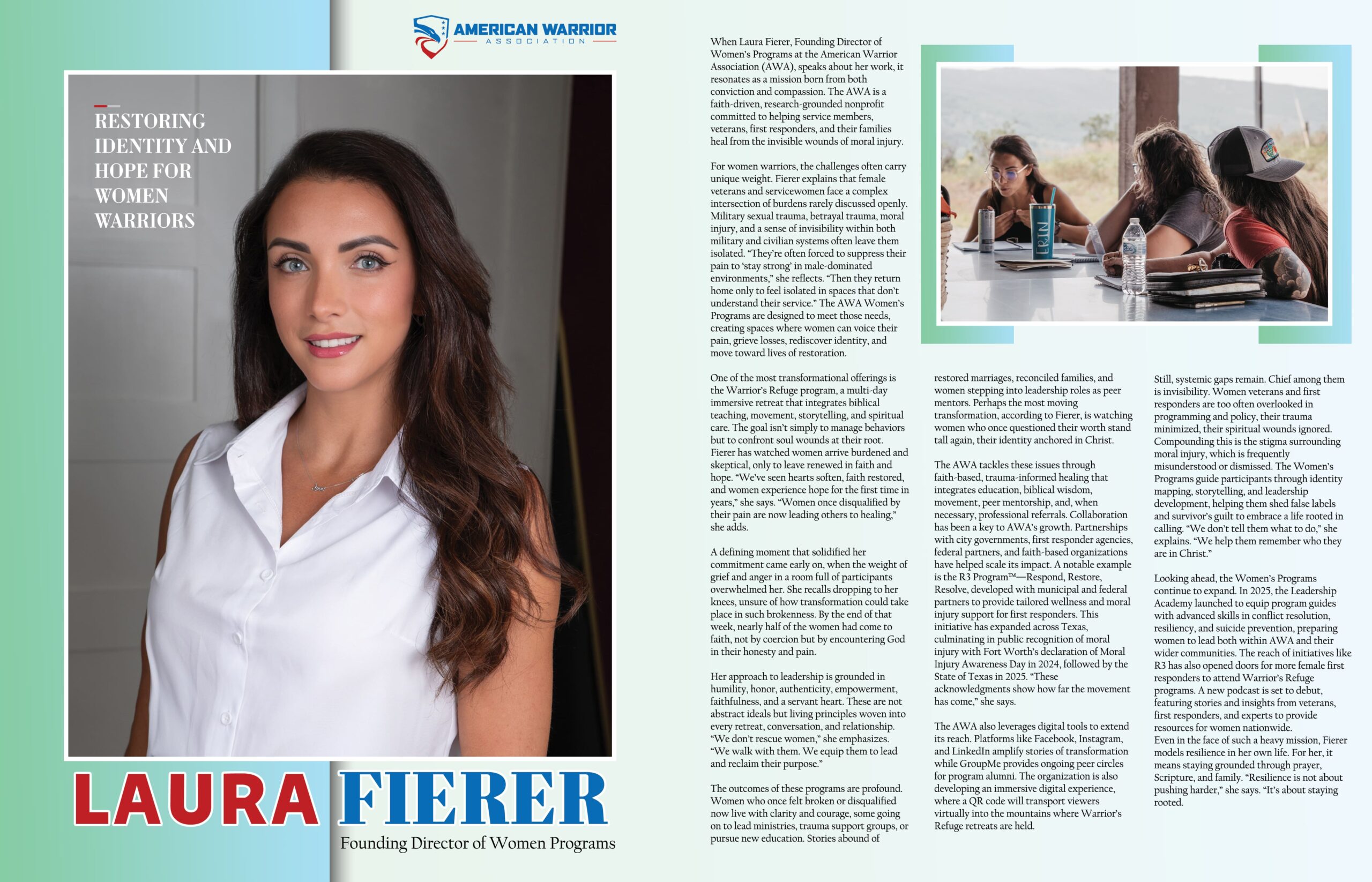
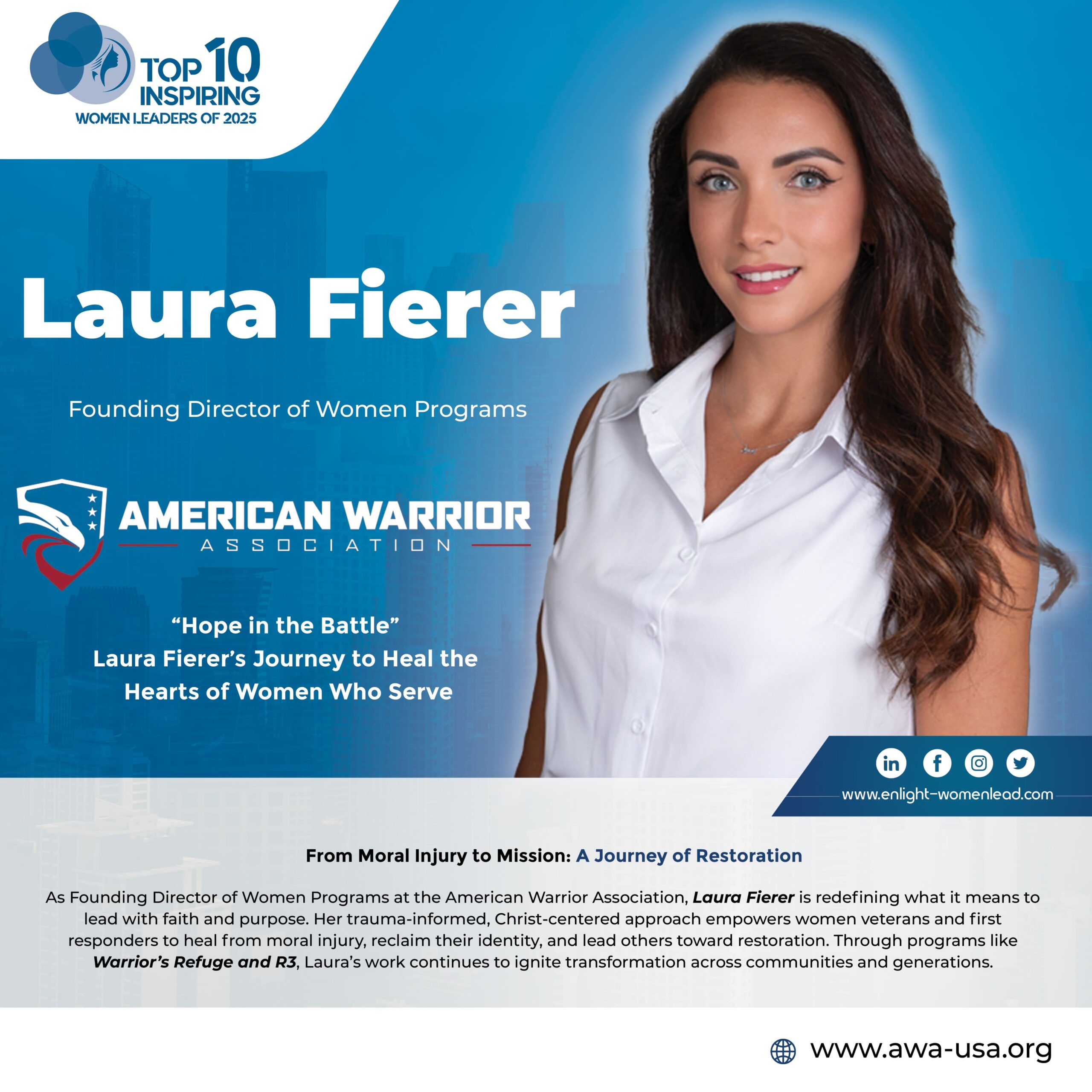
Laura Fierer
Founding Director of Women Programs
American Warrior Association (AWA)

Restoring Identity and Hope for Women Warriors
When Laura Fierer, Founding Director of Women’s Programs at the American Warrior Association (AWA), speaks about her work, it resonates as a mission born from both conviction and compassion. The AWA is a faith-driven, research-grounded nonprofit committed to helping service members, veterans, first responders, and their families heal from the invisible wounds of moral injury.
For women warriors, the challenges often carry unique weight. Fierer explains that female veterans and servicewomen face a complex intersection of burdens rarely discussed openly. Military sexual trauma, betrayal trauma, moral injury, and a sense of invisibility within both military and civilian systems often leave them isolated. “They’re often forced to suppress their pain to ‘stay strong’ in male-dominated environments,” she reflects. “Then they return home only to feel isolated in spaces that don’t understand their service.” The AWA Women’s Programs are designed to meet those needs, creating spaces where women can voice their pain, grieve losses, rediscover identity, and move toward lives of restoration.
One of the most transformational offerings is the Warrior’s Refuge program, a multi-day immersive retreat that integrates biblical teaching, movement, storytelling, and spiritual care. The goal isn’t simply to manage behaviors but to confront soul wounds at their root. Fierer has watched women arrive burdened and skeptical, only to leave renewed in faith and hope. “We’ve seen hearts soften, faith restored, and women experience hope for the first time in years,” she says. “Women once disqualified by their pain are now leading others to healing,” she adds.
A defining moment that solidified her commitment came early on, when the weight of grief and anger in a room full of participants overwhelmed her. She recalls dropping to her knees, unsure of how transformation could take place in such brokenness. By the end of that week, nearly half of the women had come to faith, not by coercion but by encountering God in their honesty and pain.
Her approach to leadership is grounded in humility, honor, authenticity, empowerment, faithfulness, and a servant heart. These are not abstract ideals but living principles woven into every retreat, conversation, and relationship. “We don’t rescue women,” she emphasizes. “We walk with them. We equip them to lead and reclaim their purpose.”
The outcomes of these programs are profound. Women who once felt broken or disqualified now live with clarity and courage, some going on to lead ministries, trauma support groups, or pursue new education. Stories abound of restored marriages, reconciled families, and women stepping into leadership roles as peer mentors. Perhaps the most moving transformation, according to Fierer, is watching women who once questioned their worth stand tall again, their identity anchored in Christ.
The AWA tackles these issues through faith-based, trauma-informed healing that integrates education, biblical wisdom, movement, peer mentorship, and, when necessary, professional referrals. Collaboration has been a key to AWA’s growth. Partnerships with city governments, first responder agencies, federal partners, and faith-based organizations have helped scale its impact. A notable example is the R3 Program™—Respond, Restore, Resolve, developed with municipal and federal partners to provide tailored wellness and moral injury support for first responders. This initiative has expanded across Texas, culminating in public recognition of moral injury with Fort Worth’s declaration of Moral Injury Awareness Day in 2024, followed by the State of Texas in 2025. “These acknowledgments show how far the movement has come,” she says.
The AWA also leverages digital tools to extend its reach. Platforms like Facebook, Instagram, and LinkedIn amplify stories of transformation while GroupMe provides ongoing peer circles for program alumni. The organization is also developing an immersive digital experience, where a QR code will transport viewers virtually into the mountains where Warrior’s Refuge retreats are held.
Still, systemic gaps remain. Chief among them is invisibility. Women veterans and first responders are too often overlooked in programming and policy, their trauma minimized, their spiritual wounds ignored. Compounding this is the stigma surrounding moral injury, which is frequently misunderstood or dismissed. The Women’s Programs guide participants through identity mapping, storytelling, and leadership development, helping them shed false labels and survivor’s guilt to embrace a life rooted in calling. “We don’t tell them what to do,” she explains. “We help them remember who they are in Christ.”
Looking ahead, the Women’s Programs continue to expand. In 2025, the Leadership Academy launched to equip program guides with advanced skills in conflict resolution, resiliency, and suicide prevention, preparing women to lead both within AWA and their wider communities. The reach of initiatives like R3 has also opened doors for more female first responders to attend Warrior’s Refuge programs. A new podcast is set to debut, featuring stories and insights from veterans, first responders, and experts to provide resources for women nationwide.
Even in the face of such a heavy mission, Fierer models resilience in her own life. For her, it means staying grounded through prayer, Scripture, and family. “Resilience is not about pushing harder,” she says. “It’s about staying rooted.”