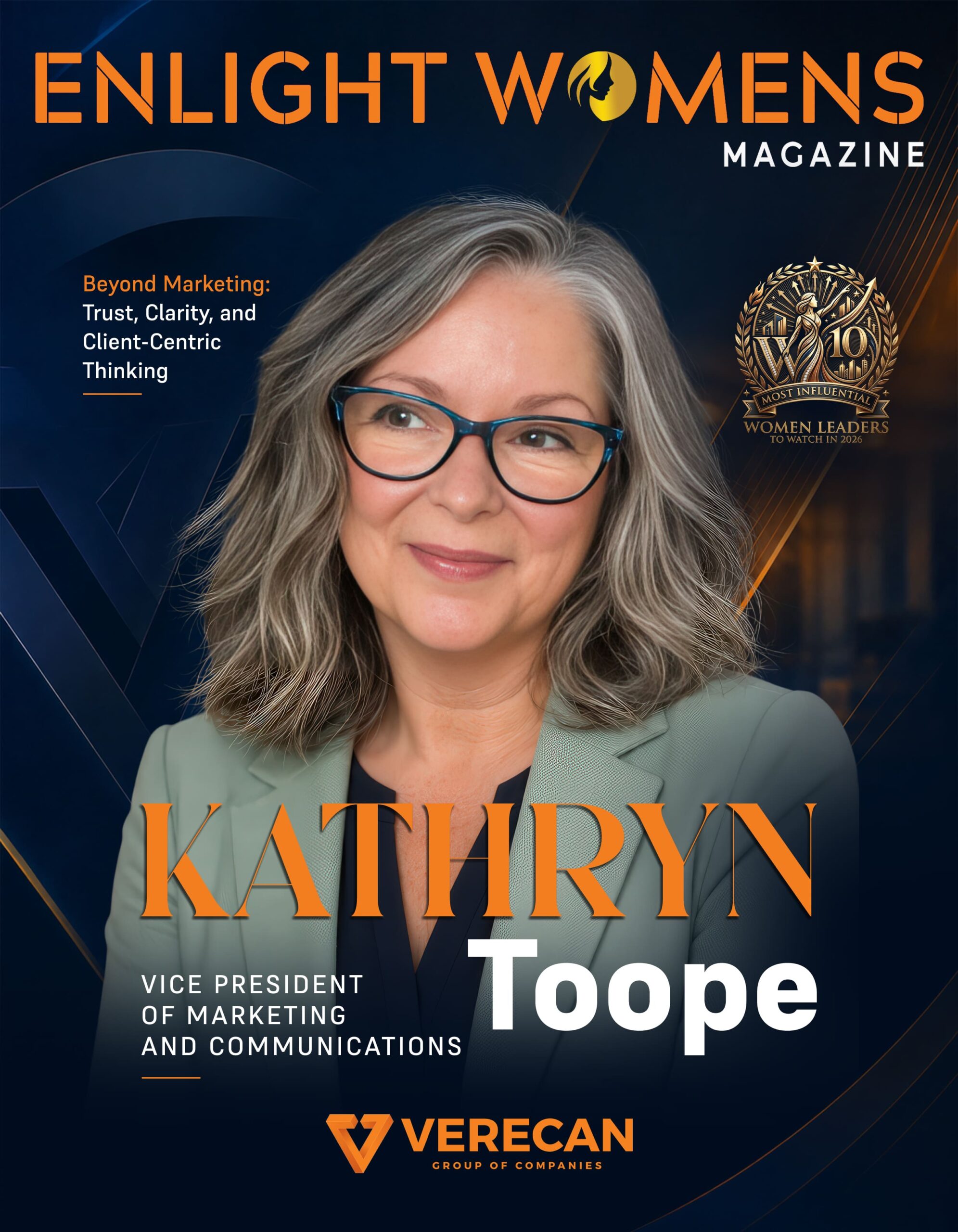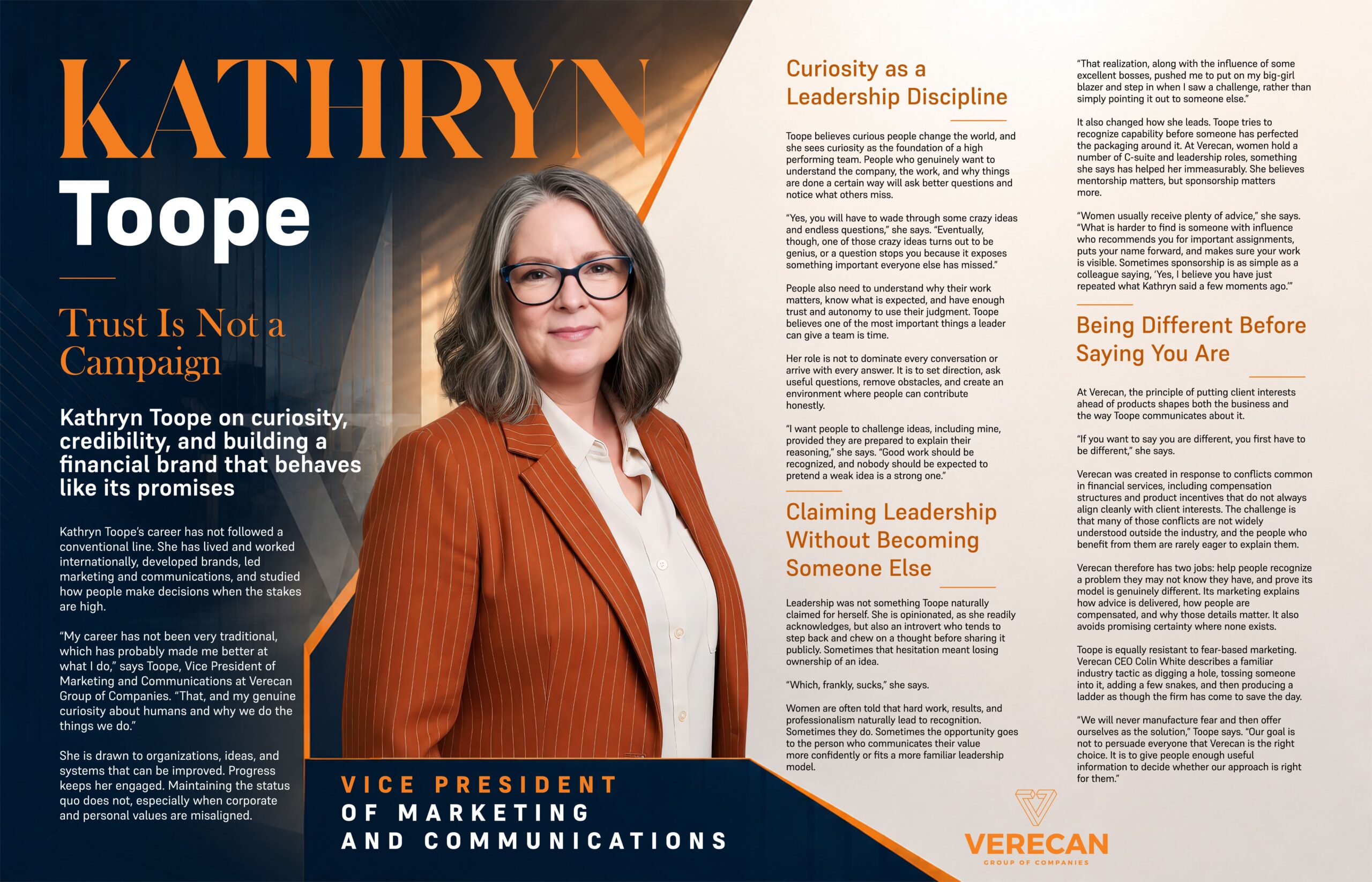
Trust Is Not a Campaign
Kathryn Toope on curiosity, credibility, and building a financial brand that behaves like its promises
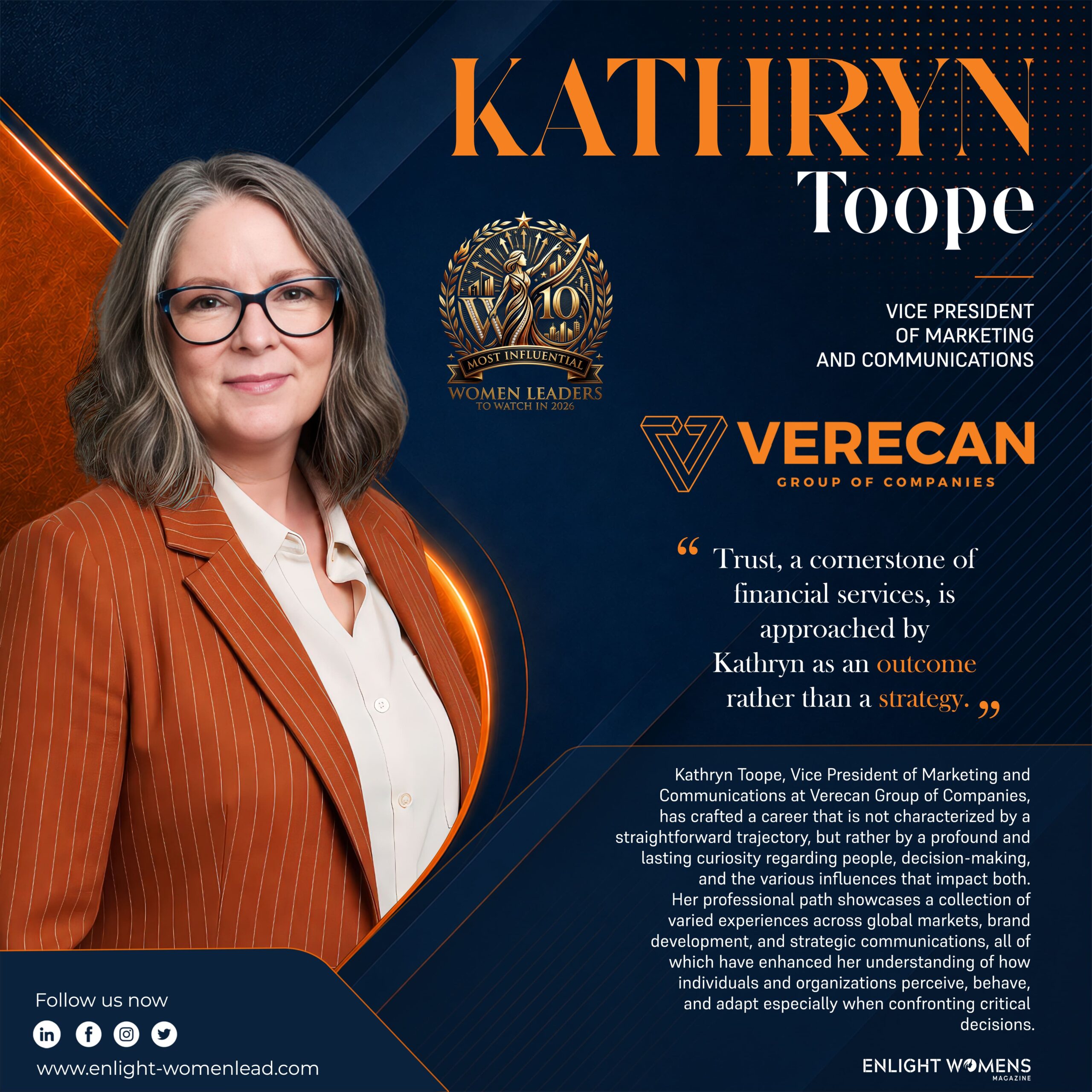
Kathryn Toope’s career has not followed a conventional line. She has lived and worked internationally, developed brands, led marketing and communications, and studied how people make decisions when the stakes are high.
“My career has not been very traditional, which has probably made me better at what I do,” says Toope, Vice President of Marketing and Communications at Verecan Group of Companies. “That, and my genuine curiosity about humans and why we do the things we do.”
She is drawn to organizations, ideas, and systems that can be improved. Progress keeps her engaged. Maintaining the status quo does not, especially when corporate and personal values are misaligned.
Curiosity as a Leadership Discipline
Toope believes curious people change the world, and she sees curiosity as the foundation of a high- performing team. People who genuinely want to understand the company, the work, and why things are done a certain way will ask better questions and notice what others miss.
“Yes, you will have to wade through some crazy ideas and endless questions,” she says. “Eventually, though, one of those crazy ideas turns out to be genius, or a question stops you because it exposes something important everyone else has missed.”
People also need to understand why their work matters, know what is expected, and have enough trust and autonomy to use their judgment. Toope believes one of the most important things a leader can give a team is time.
Her role is not to dominate every conversation or arrive with every answer. It is to set direction, ask useful questions, remove obstacles, and create an environment where people can contribute honestly.
“I want people to challenge ideas, including mine, provided they are prepared to explain their reasoning,” she says. “Good work should be recognized, and nobody should be expected to pretend a weak idea is a strong one.”
Claiming Leadership Without Becoming Someone Else
Leadership was not something Toope naturally claimed for herself. She is opinionated, as she readily acknowledges, but also an introvert who tends to step back and chew on a thought before sharing it publicly. Sometimes that hesitation meant losing ownership of an idea.
“Which, frankly, sucks,” she says.
Women are often told that hard work, results, and professionalism naturally lead to recognition. Sometimes they do. Sometimes the opportunity goes to the person who communicates their value more confidently or fits a more familiar leadership model.
“That realization, along with the influence of some excellent bosses, pushed me to put on my big-girl blazer and step in when I saw a challenge, rather than simply pointing it out to someone else.”
It also changed how she leads. Toope tries to recognize capability before someone has perfected the packaging around it. At Verecan, women hold a number of C-suite and leadership roles, something she says has helped her immeasurably. She believes mentorship matters, but sponsorship matters more.
“Women usually receive plenty of advice,” she says. “What is harder to find is someone with influence who recommends you for important assignments, puts your name forward, and makes sure your work is visible. Sometimes sponsorship is as simple as a colleague saying, ‘Yes, I believe you have just repeated what Kathryn said a few moments ago.”
Being Different Before Saying You Are
At Verecan, the principle of putting client interests ahead of products shapes both the business and the way Toope communicates about it.
“If you want to say you are different, you first have to be different,” she says.
Verecan was created in response to conflicts common in financial services, including compensation structures and product incentives that do not always align cleanly with client interests. The challenge is that many of those conflicts are not widely understood outside the industry, and the people who benefit from them are rarely eager to explain them.
Verecan therefore has two jobs: help people recognize a problem they may not know they have, and prove its model is genuinely different. Its marketing explains how advice is delivered, how people are compensated, and why those details matter. It also avoids promising certainty where none exists.
Toope is equally resistant to fear-based marketing. Verecan CEO Colin White describes a familiar industry tactic as digging a hole, tossing someone into it, adding a few snakes, and then producing a ladder as though the firm has come to save the day.
“We will never manufacture fear and then offer ourselves as the solution,” Toope says. “Our goal is not to persuade everyone that Verecan is the right choice. It is to give people enough useful information to decide whether our approach is right for them.”
Trust as an Operating Standard
Trust, in Toope’s view, is not a slogan or a communications objective. It is the result of consistency between what an organization says and what it does.
“At a distance, we do that through marketing,” she says. “Up close, we do it by being who we said we were in the first place.”
That requires clarity about fees, conflicts, risk, responsibilities, and expectations. It also demands internal alignment. Marketing cannot invent a version of the business that operations, compliance, portfolio management, and client service are expected to support.
“Trust is not a campaign,” Toope says. “It is the accumulated result of many small, important decisions made consistently over time.”
Education is central to that work. Through podcasts, newsletters, articles, videos, and market commentary, people can experience how Verecan thinks before they ever speak with the firm.
Verecan’s commitment extends beyond its own content. The firm funds the Verecan Chair in Behavioural Finance at the University of Toronto, held by Dr. Lisa Kramer, whose research examines how psychology, emotion, and human behaviour influence financial decisions.
“Supporting that work reflects our belief that the industry needs to keep learning, not simply keep repeating what it already believes,” Toope says.
More Information Is Not Always More Helpful
As client expectations evolve, Toope believes firms need to adapt without becoming unrecognizable. Clients want information that is clear, timely, accessible, and available in the format that works for them. Some prefer a detailed conversation. Others want a concise email, short video, podcast, or online resource.
Client-centric communication does not mean reacting to every trend or producing more simply to increase volume. “More information is not always more helpful,” she says. “The challenge is to understand what people need and communicate when it is useful.”
That same judgment applies to artificial intelligence. AI will make it faster and less expensive to produce, analyze, personalize, and distribute information. It will create real opportunities and, as Toope puts it, “a massive volume of truly, painfully mediocre content.”
Access to AI will be table stakes. The advantage will come from judgment: knowing what is worth saying, what is accurate, what is appropriate, and what should never have been published.
“Used well, AI can help skilled professionals work more effectively,” she says. “If we get it right, it should strengthen human judgment, not replace it. If we get it wrong, we will sound like everyone else, and people will notice.”
Data raises a similar question. The fact that an organization can use a piece of information does not mean it should. Verecan has deliberately declined to use some marketing practices that may be technically compliant but do not meet its standard for client trust.
“Our rule of thumb is simple: if we believe a client would reasonably be uncomfortable with something, it is not happening,” Toope says. “We aim higher than technical compliance.”
The Future of Advice Is More Human, Not Less
Clients increasingly expect advice to reflect their whole financial life, connecting investments with retirement planning, taxes, insurance, estate considerations, debt, business ownership, family responsibilities, and major decisions.
Toope welcomes better-informed clients. Good advisors should not feel threatened when people research strategies, compare providers, or question advice. At the same time, more information can create more confusion. The future of advice will not be about supplying endless data. It will be about helping people understand what matters and make sound decisions.
An AI-generated financial plan may calculate how much someone should save each month. It may not know that the person routinely overspends on travel, has health concerns likely to re-emerge, or is supporting a family member unless the right questions are asked.
“Without context, the answer may be mathematically correct and still be bad advice,” Toope says.
She expects greater transparency, more integrated advice, increased use of technology, continued consolidation, and growing demand for cross-border expertise. As basic offerings become easier to replicate, judgment, client experience, and the ability to coordinate complex needs will matter more.
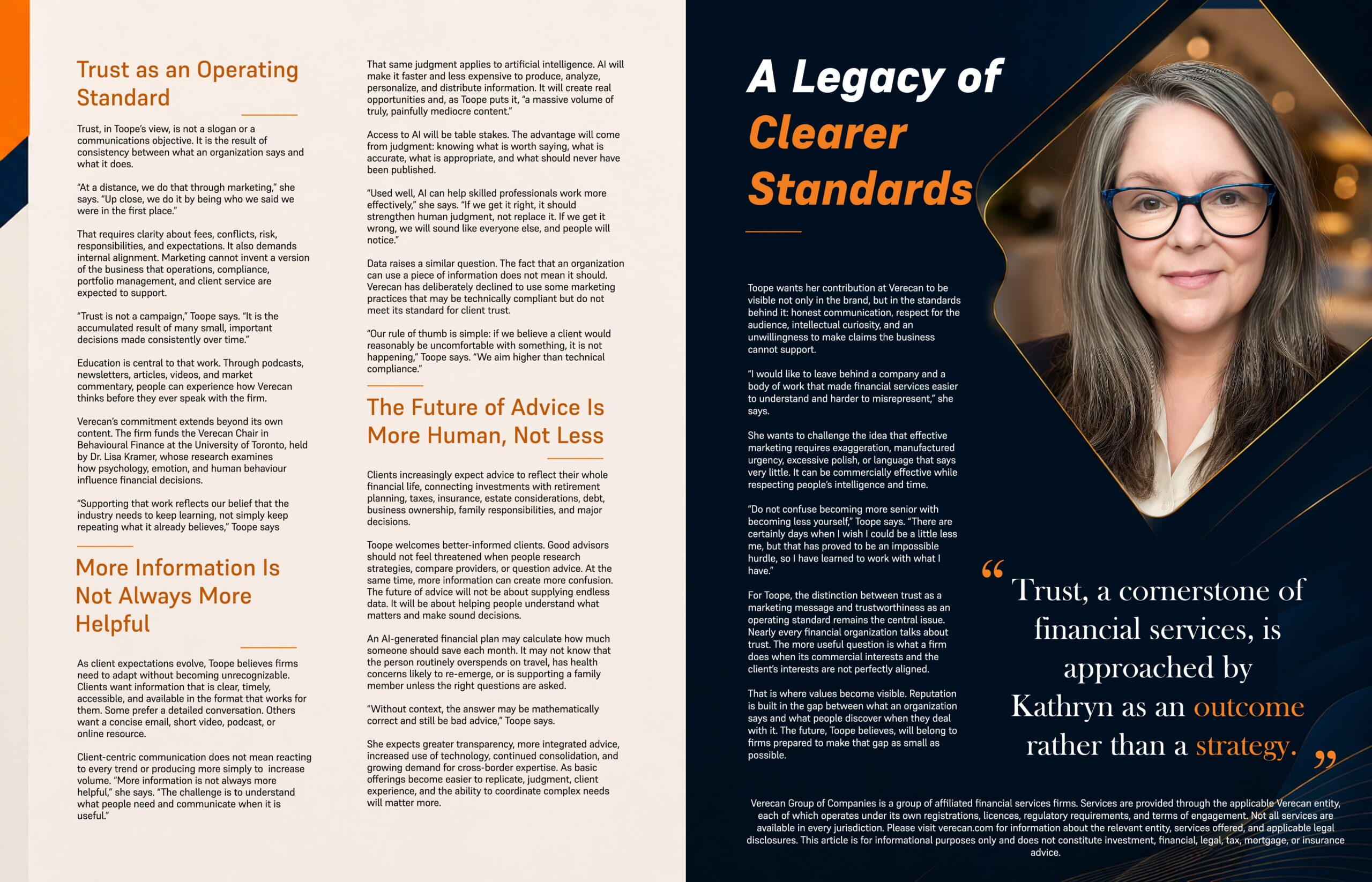
A Legacy of Clearer Standards
Toope wants her contribution at Verecan to be visible not only in the brand, but in the standards behind it: honest communication, respect for the audience, intellectual curiosity, and an unwillingness to make claims the business cannot support.
“I would like to leave behind a company and a body of work that made financial services easier to understand and harder to misrepresent,” she says.
She wants to challenge the idea that effective marketing requires exaggeration, manufactured urgency, excessive polish, or language that says very little. It can be commercially effective while respecting people’s intelligence and time.
Her advice to women seeking senior leadership reflects that same philosophy. Leadership is not only about being ready when someone calls. The bigger opportunity may lie in seeing a gap and being willing to become the person who fills it.
“Do not confuse becoming more senior with becoming less yourself,” Toope says. “There are certainly days when I wish I could be a little less me, but that has proved to be an impossible hurdle, so I have learned to work with what I have.”
For Toope, the distinction between trust as a marketing message and trustworthiness as an operating standard remains the central issue. Nearly every financial organization talks about trust. The more useful question is what a firm does when its commercial interests and the client’s interests are not perfectly aligned.
That is where values become visible. Reputation is built in the gap between what an organization says and what people discover when they deal with it. The future, Toope believes, will belong to firms prepared to make that gap as small as possible.
Verecan Group of Companies is a group of affiliated financial services firms. Services are provided through the applicable Verecan entity, each of which operates under its own registrations, licences, regulatory requirements, and terms of engagement. Not all services are available in every jurisdiction. Please visit verecan.com for information about the relevant entity, services offered, and applicable legal disclosures. This article is for informational purposes only and does not constitute investment, financial, legal, tax, mortgage, or insurance advice.
“True leadership is built on curiosity, strengthened by integrity, and remembered through the positive change we create in the lives of others.” — Kathryn Toope | Vice President of Marketing and Communications, Verecan Group of Companies