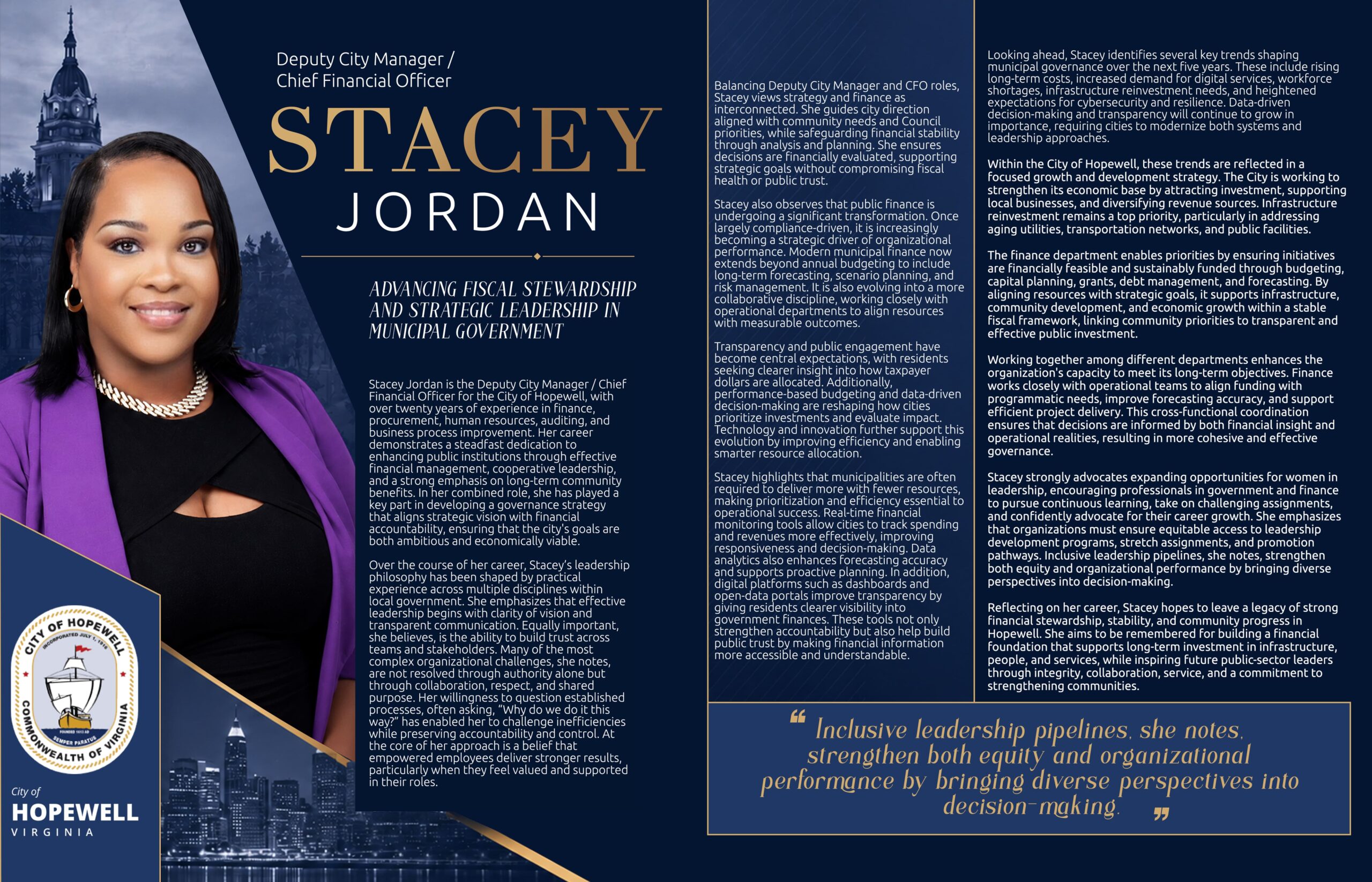
Shaping Sustainable Municipal Growth Through Strategic Financial Leadership
Advancing Fiscal Stewardship and Strategic Leadership in Municipal Government
Stacey Jordan is the Deputy City Manager / Chief Financial Officer for the City of Hopewell, with over twenty years of experience in finance, procurement, human resources, auditing, and business process improvement. Her career demonstrates a steadfast dedication to enhancing public institutions through effective financial management, cooperative leadership, and a strong emphasis on long-term community benefits. In her combined role, she has played a key part in developing a governance strategy that aligns strategic vision with financial accountability, ensuring that the city’s goals are both ambitious and economically viable.
Over the course of her career, Stacey’s leadership philosophy has been shaped by practical experience across multiple disciplines within local government. She emphasizes that effective leadership begins with clarity of vision and transparent communication. Equally important, she believes, is the ability to build trust across teams and stakeholders. Many of the most complex organizational challenges, she notes, are not resolved through authority alone but through collaboration, respect, and shared purpose. Her willingness to question established processes often asking, “Why do we do it this way?” has enabled her to challenge inefficiencies while preserving accountability and control. At the core of her approach is a belief that empowered employees deliver stronger results, particularly when they feel valued and supported in their roles.
Balancing Deputy City Manager and CFO roles, Stacey views strategy and finance as interconnected. She guides city direction aligned with community needs and Council priorities, while safeguarding financial stability through analysis and planning. She ensures decisions are financially evaluated, supporting strategic goals without compromising fiscal health or public trust.
Stacey also observes that public finance is undergoing a significant transformation. Once largely compliance-driven, it is increasingly becoming a strategic driver of organizational performance. Modern municipal finance now extends beyond annual budgeting to include long-term forecasting, scenario planning, and risk management. It is also evolving into a more collaborative discipline, working closely with operational departments to align resources with measurable outcomes.
Transparency and public engagement have become central expectations, with residents seeking clearer insight into how taxpayer dollars are allocated. Additionally, performance-based budgeting and data-driven decision-making are reshaping how cities prioritize investments and evaluate impact. Technology and innovation further support this evolution by improving efficiency and enabling smarter resource allocation.
Stacey highlights that municipalities are often required to deliver more with fewer resources, making prioritization and efficiency essential to operational success. Real-time financial monitoring tools allow cities to track spending and revenues more effectively, improving responsiveness and decision-making. Data analytics also enhances forecasting accuracy and supports proactive planning. In addition, digital platforms such as dashboards and open-data portals improve transparency by giving residents clearer visibility into government finances. These tools not only strengthen accountability but also help build public trust by making financial information more accessible and understandable.
Where Strategy Meets Stewardship: Leadership in Modern Municipal Finance
Looking ahead, Stacey identifies several key trends shaping municipal governance over the next five years. These include rising long-term costs, increased demand for digital services, workforce shortages, infrastructure reinvestment needs, and heightened expectations for cybersecurity and resilience. Data-driven decision-making and transparency will continue to grow in importance, requiring cities to modernize both systems and leadership approaches.
Within the City of Hopewell, these trends are reflected in a focused growth and development strategy. The City is working to strengthen its economic base by attracting investment, supporting local businesses, and diversifying revenue sources. Infrastructure reinvestment remains a top priority, particularly in addressing aging utilities, transportation networks, and public facilities.
The finance department enables priorities by ensuring initiatives are financially feasible and sustainably funded through budgeting, capital planning, grants, debt management, and forecasting. By aligning resources with strategic goals, it supports infrastructure, community development, and economic growth within a stable fiscal framework, linking community priorities to transparent and effective public investment.
Working together among different departments enhances the organization's capacity to meet its long-term objectives. Finance works closely with operational teams to align funding with programmatic needs, improve forecasting accuracy, and support efficient project delivery. This cross-functional coordination ensures that decisions are informed by both financial insight and operational realities, resulting in more cohesive and effective governance.
Stacey strongly advocates expanding opportunities for women in leadership, encouraging professionals in government and finance to pursue continuous learning, take on challenging assignments, and confidently advocate for their career growth. She emphasizes that organizations must ensure equitable access to leadership development programs, stretch assignments, and promotion pathways. Inclusive leadership pipelines, she notes, strengthen both equity and organizational performance by bringing diverse perspectives into decision-making.
Reflecting on her career, Stacey hopes to leave a legacy of strong financial stewardship, stability, and community progress in Hopewell. She aims to be remembered for building a financial foundation that supports long-term investment in infrastructure, people, and services, while inspiring future public-sector leaders through integrity, collaboration, service, and a commitment to strengthening communities.
“As public administration continues to evolve, Stacey Jordan stands among the leaders redefining what modern municipal leadership looks like. By combining financial excellence with strategic governance and people-centered leadership, she is building more than balanced budgets—she is building trust, resilience, and a future where communities can confidently thrive.”