For Karen Haugen, leadership means balancing tradition with progress. After two decades in senior roles at Parks Canada, where she worked closely with Indigenous groups across Canada, she felt called to return home. As Executive Director of Huu-ay-aht First Nations, she now uses that experience to guide her Nation into the next stage of self-governance.
Haugen’s priorities for Huu-ay-aht today are clear: the Nation must create a thriving, healthy, and vibrant economy that attracts investors who are interested in investing in its future. She sees Huu-ay-aht as a community with enormous potential, one that could become a major hub in British Columbia and a true gateway to the Pacific. She believes this potential can only be realized by forming partnerships that align with Huu-ay-aht’s values as well as its economic goals. This commitment is captured in the Framework Vision Plan, a long-term roadmap for building a sustainable economy that balances growth with the needs of citizens and the environment.
The foundation for all of this lies in the sacred principles that guide Huu-ay-aht governance. Haugen explains that her Nation is deeply rooted in three values: ʔiisaak, which means respect; ʔuuʔałuk, or taking care of; and Hišuk ma c̕awak, which means everything is one. These principles are practical guides to leadership. For her, respect means holding herself and her team to the highest ethical and professional standards, always striving for impartiality and fairness in decision-making. Taking care of means nurturing relationships, whether with citizens, communities, or partners, and ensuring collaboration is genuine. And “everything is one” is about blending the strengths of both Western governance and First Nations traditions to create an inclusive vision that benefits everyone.
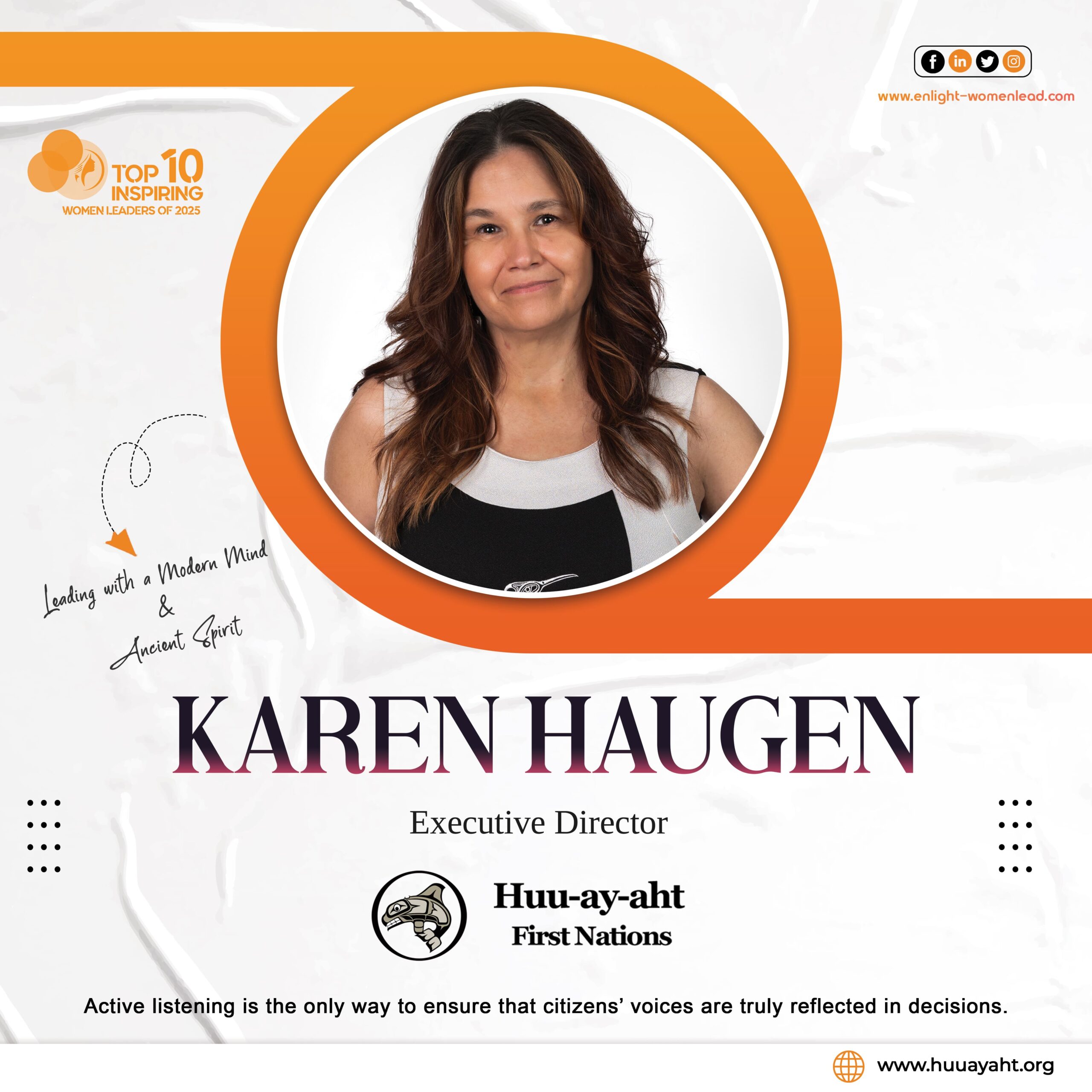
In all her work, Haugen carries with her a lesson from her grandmother: the difference between hearing and listening. “Don’t come here to just hear me, come here to listen to me,” her grandmother told her. For Haugen, that has meant leading with open eyes, ears, and heart. Active listening has become her philosophy, and she believes it is the only way to ensure that the voices of citizens are truly reflected in the Nation’s decisions. Whether developing policy or setting strategy, she makes it a point to acknowledge contributions and ensure that every citizen feels part of the process.
Huu-ay-aht’s progress is also visible in the tangible ways it supports its people. Housing and infrastructure have been a major focus in recent years, with the creation of a Housing Society that provides low-cost and social housing. In just five years, the Nation has built multiple units, with new projects already underway. Beyond the community, programs extend to urban citizens, supporting them with renovations, down payments, or rental assistance. There are also plans to work with the Province of British Columbia to develop transitional housing linked to the Oomiiqsu, or Mother Centre, ensuring mothers and their families have a path toward long-term stability.
Collaboration, too, is essential. Haugen stresses that no government, especially a young one, can succeed in isolation. Although Huu-ay-aht’s formal government is less than 15 years old, its people have lived on their lands since time immemorial. Building relationships with provincial and federal governments, as well as with international partners, has been key to advancing their goals. At the same time, Huu-ay-aht plays an active role in regional and national Indigenous governance, ensuring that its voice contributes to broader efforts such as the implementation of the United Nations Declaration on the Rights of Indigenous Peoples. For Haugen, progress requires Indigenous Nations to stand together, especially when addressing long-standing challenges in health, education, poverty, and justice.
Her own leadership philosophy is shaped by the idea that Huu-ay-aht is not simply adapting a colonial model of governance but building something distinct, rooted in its own traditions and needs. She often describes it as leading with a “Modern Mind and Ancient Spirit.” When asked what she hopes her legacy will be, Haugen says she wants to be remembered for forging strong partnerships that brought prosperity to her Nation without sacrificing culture or identity. She hopes to have left behind a government that is financially self-sustaining, yet deeply connected to its traditions. Looking ahead, her vision for the next decade is one of flourishing: citizens who are healthy, strong, and safe; communities where families thrive; and a Nation that has grown in both wealth and spirit.
For Karen Haugen, leadership at Huu-ay-aht is not simply about economic growth or political power. It is about honoring the past while preparing for the future. It is about listening as much as speaking, building as much as protecting, and ensuring that progress never comes at the expense of identity.